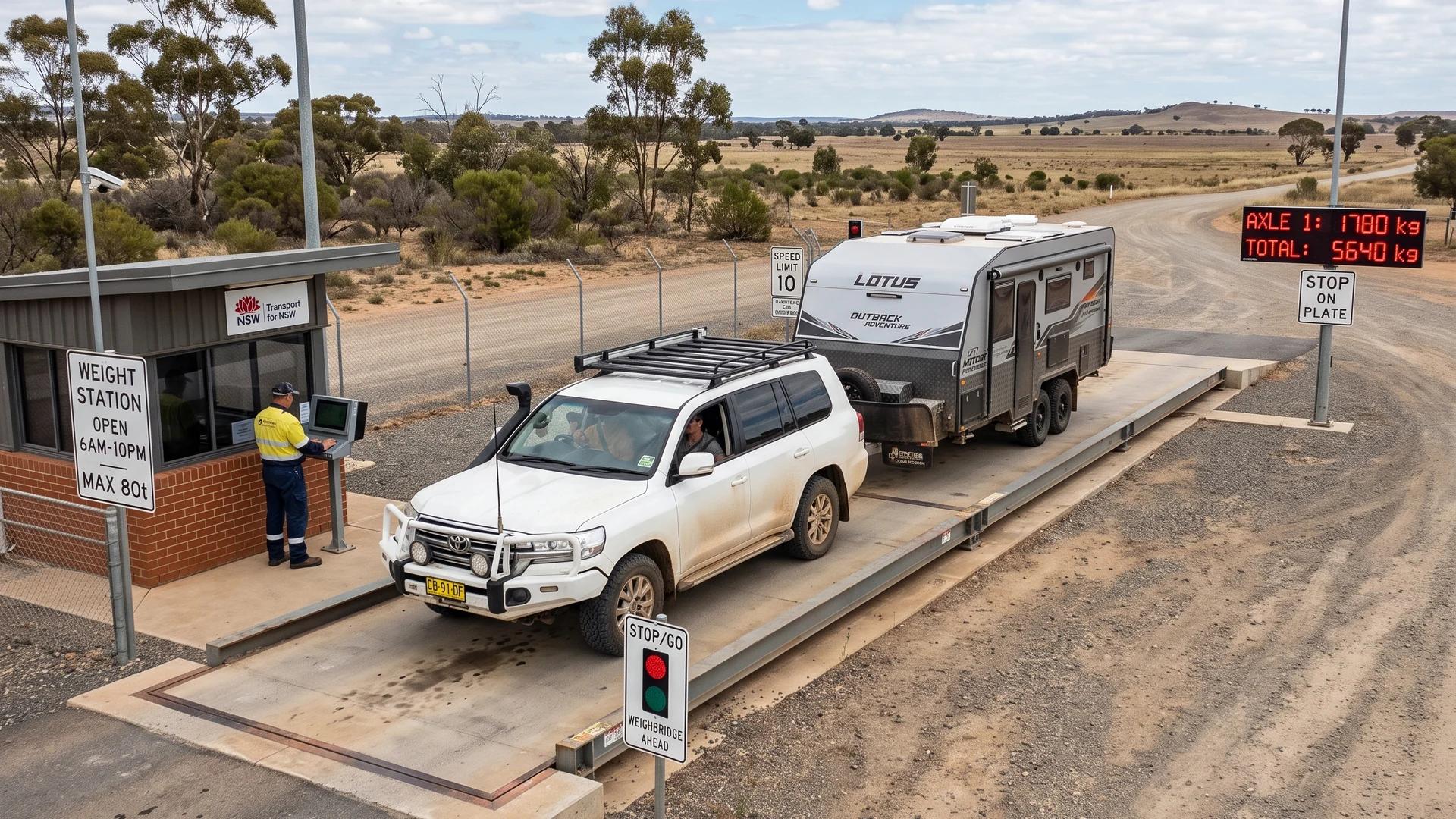
Every towing weight rating on your compliance plate is a number you are legally required to stay under. The only way to know whether you actually are — not estimate, not assume, but know — is to drive your loaded rig onto a weighbridge and read the figures off the scale. Everything else is a calculation waiting to be confirmed.
The problem is that most caravanners have never done it. The process feels opaque, the terminology is intimidating, and it is not obvious where the nearest public weighbridge even is. This guide walks through the whole thing: finding a weighbridge, what to weigh and in what order, and how to turn the numbers on the ticket into a clear picture of whether your rig is legal.
Why a Weighbridge Beats a Guess
Manufacturers publish a tare weight and a payload figure, and it is tempting to add up the weight of your gear and trust the maths. The trouble is that published tare weights are frequently optimistic — many vans leave the factory 100 to 300 kg heavier than the brochure figure once options are fitted — and almost nobody accurately accounts for water, gas, and the slow accumulation of "essential" gear. Weighbridge audits consistently find a significant share of caravans on Australian roads travelling over one limit or another, and their owners are almost always surprised.
A weighbridge removes the guesswork. It tells you your real, loaded, on-the-road weights, which you then compare against the ratings stamped on your plates. If you are under every limit, you have proof. If you are over, you have found out in a car park instead of at a roadside inspection or, worse, through a tyre failure at highway speed.
Where to Find a Public Weighbridge
Public weighbridges are more common than most people realise — you have probably driven past several without noticing. The main sources are:
State road and transport authorities. Most states operate public weighbridges, and several publish a list of locations on their transport authority website. These are trade-certified and designed for exactly this purpose.
Grain handlers, saleyards, and transfer stations. Rural weighbridges at grain co-ops, livestock saleyards, and waste transfer stations are frequently open to the public for a small fee. Availability varies by season and site — call ahead.
Some service stations and truck stops. Larger highway service centres that cater to trucks sometimes have a public weighbridge on site.
Fees are modest. A typical public weigh costs between $15 and $30, and some council or authority-run bridges are free. Call before you drive out: confirm the bridge is open to the public, whether you need to book, and whether the operator can give you individual axle readings or only a single gross figure.
If you would rather not hunt around, Ready2Tow includes a weighbridge locator that maps public weighbridges near you. As with any locator, the data is a guide only — operating hours and public access change, so ring the site to confirm before you travel.
What You Need Before You Go
Weigh your rig loaded exactly as you travel. That means full water tanks, gas bottles fitted, fridge stocked, clothes and tools packed where they normally sit, and anything that rides on the drawbar or roof in place. A weigh done with empty tanks and no gear produces a number that is useless the moment you actually hit the road.
Have your compliance plate figures written down before you arrive so you can compare on the spot. From the tow vehicle you want its GVM (Gross Vehicle Mass) and the combination's GCM (Gross Combination Mass); from the caravan you want its ATM (Aggregate Trailer Mass) and GTM (Gross Trailer Mass). If those acronyms are a blur, our guide to GVM, ATM, GCM and the rest explains each one in plain English.
The Weighing Sequence
The goal is to capture four things: your loaded tow vehicle weight, your loaded caravan weight, the combined weight, and your tow ball weight. On a standard single-platform weighbridge you can get all of them with a few passes.
1. Weigh the tow vehicle alone, fully loaded and unhitched. Drive the car (with passengers and gear as you travel, but the van disconnected) fully onto the platform. This reading is your loaded vehicle weight — compare it against your GVM.
2. Weigh the whole combination, hitched. Hitch up and drive the entire rig onto the platform so both the car and the van sit on the scale. This total is your combined weight — compare it against your GCM. Remember that GCM is often less than GVM plus your maximum tow rating, so this is the number that catches people who are individually under each limit but over in combination.
3. Weigh the caravan alone to get ATM. Unhitch and position the fully loaded caravan — wheels and jockey wheel, the whole van — entirely on the platform. This is your ATM. Compare it against the ATM on the van's plate.
4. Split out GTM and ball weight. With the van still disconnected, take a reading with only the caravan's wheels on the platform (jockey wheel and any support just off the scale). That reading is your GTM — the load carried by the caravan's axles. Your tow ball weight is simply ATM minus GTM — the portion of the van's weight that transfers forward onto your car's hitch. Healthy ball weight is generally around 8 to 12 per cent of the loaded van weight; too little invites sway, too much overloads the car's rear axle.
Not every public weighbridge makes it easy to split the van like this — some are a single drive-over gross weigh only. If yours is, you can still get your total and combination figures, and use a dedicated tow ball scale at home for the ball weight. For a full per-wheel breakdown — which reveals side-to-side imbalance you cannot see any other way — look for a mobile weighing service or a weighbridge with individual wheel pads.
Reading the Results
Lay your four measured weights next to your four plate ratings:
- Loaded vehicle weight vs GVM — is the car itself under its limit once the ball weight is on it?
- Caravan weight vs ATM — is the loaded van under its own limit?
- Combination vs GCM — is the pair under the combined limit?
- GTM vs the van's axle rating, and ball weight vs the car's rear axle and towbar rating.
If every measured figure sits under its corresponding rating, your rig is within its legal weights. If any single figure is over, you are overweight — and being under the other three does not fix it. Our guide on what to do when your caravan is overweight covers the practical ways to shed weight or, where necessary, upgrade a rating.
One more check worth doing while you have the numbers: your tyre pressures should be set for the actual load each tyre is carrying, not the maximum stamped on the sidewall. The per-axle weights from your weigh feed straight into that calculation — see how to work out the correct pressure for your load.
Do It More Than Once
Your weights are not fixed. Every time you significantly change how you pack — a new awning, a generator, a full versus half water tank, a different mix of gear for a longer trip — your numbers move. Re-weigh after any major change to your setup, and make a weighbridge visit part of your routine before a big trip rather than a one-off you did years ago and have trusted ever since.
Know Your Numbers Before You Roll On
A weighbridge gives you certified, real-world weights — the gold standard. Ready2Tow is built to work alongside that, not replace it: enter your vehicle and caravan specifications and the app calculates your GVM, ATM, GCM, GTM, and ball weight from the figures you provide, then shows colour-coded results so you can see which ratings are comfortable and which are close to the line before you ever reach the weighbridge. Scan a compliance plate and it reads the ratings for you; check the full feature list for everything it does, and the Free tier gives you a pass-or-fail weight check at no cost.
Ready2Tow provides weight and tyre pressure calculations as a guide only. It does not replace professional weighing services or qualified tyre technicians. Always verify your weights at a certified weighbridge before towing.