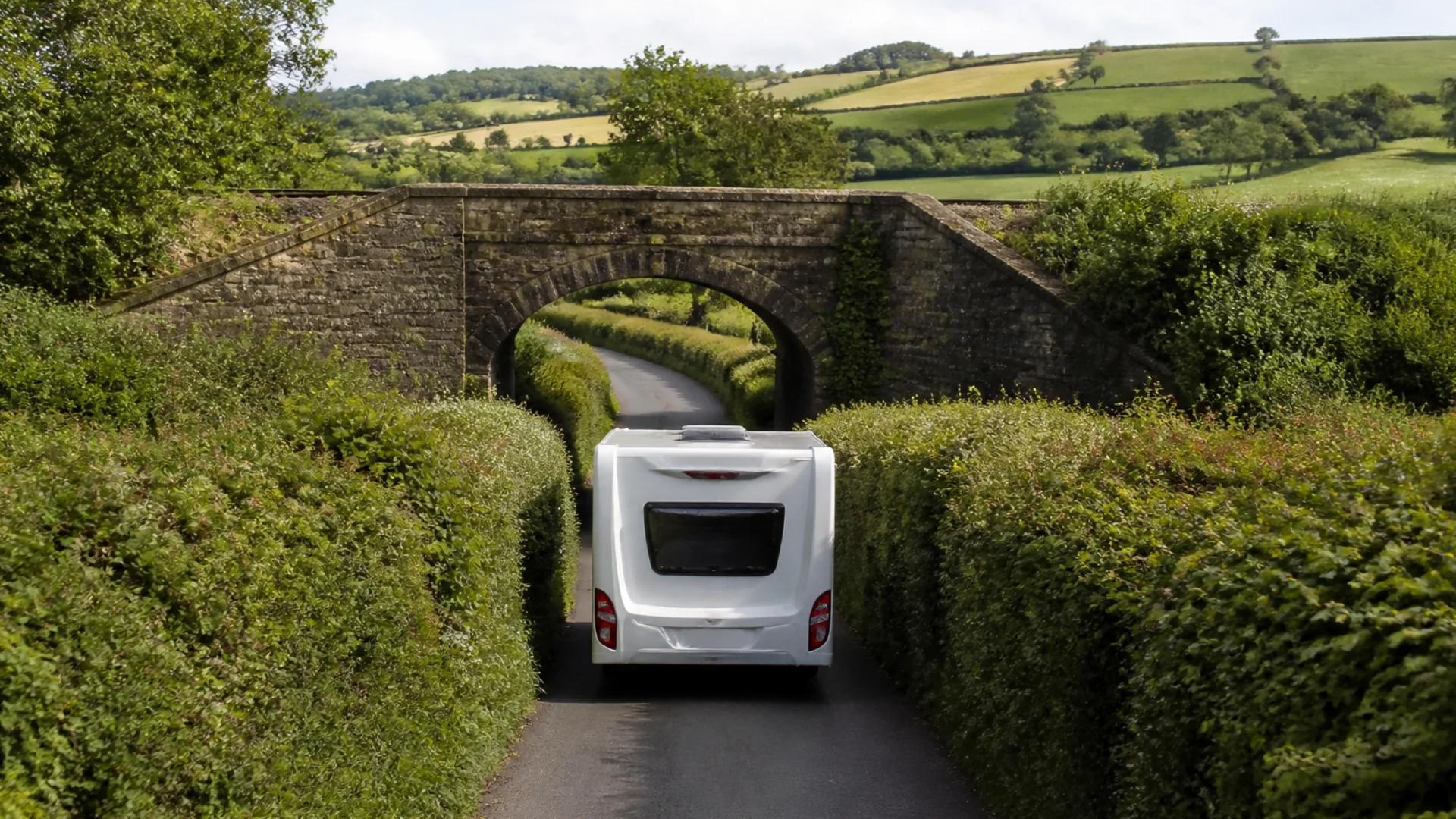
Touring Britain by caravan or motorhome is wonderful: coastal campsites, moorland, villages that haven't changed in centuries. Those same villages, and the lanes that lead to them, were built long before anyone towed a caravan. Narrow roads, tight bends, low bridges and width restrictions are part of the experience, and the sat-nav that's perfect in your car doesn't know any of it applies to you.
Here's how to plan routes that suit your whole outfit.
What car sat-nav doesn't account for
Height
Many caravans and motorhomes stand around 2.6 to 3.2 metres (roughly 8'6" to 10'6"), and more with roof air conditioning or solar. Car navigation ignores height entirely, and Britain has plenty of low railway bridges, many on otherwise ordinary roads. UK bridge signs often show the height in feet and inches as well as metres, so know your height in both.
Width and length
A car and caravan can easily run 12 metres or more. Narrow country lanes, width restrictions, tight village streets and old stone bridges are much harder at that size, and the shortest route is often the narrowest.
Weight
Some bridges and roads have weight limits. A loaded motorhome can exceed a limit that a car would never notice. Know your outfit's weights, including your caravan's MTPLM and your noseweight, and stay within them.
Hills
Some UK roads have very steep gradients, signed as percentages. A hill that a car barely notices can be a serious climb or descent with a caravan on the back.
How to plan better routes
Know your numbers
Measure your total height (to the top of the air conditioner, aerial or solar panel), total length and width, and keep the height on a note in the cab in both metres and feet. When you see a bridge sign, you shouldn't have to work it out.
Stick to A-roads where you can
A-roads and motorways are generally the safest choice for caravans and large motorhomes, even if they add a few miles. Be cautious about routes that cut through villages or along unclassified lanes.
Follow the campsite's directions
Many campsites publish recommended approach routes for caravans and motorhomes, often with a warning not to follow sat-nav for the final stretch. Read them before you go. The site owner knows which lane you really don't want.
Use passing places properly
On single-track roads, pull into a passing place on your left to let oncoming traffic through, or wait opposite one on your right. Pull in to let faster traffic behind you overtake, too. Never park in a passing place.
Plan breaks
Towing is tiring, especially on unfamiliar roads. Plan a break every couple of hours.
Trust the signs
No navigation tool knows about every temporary restriction or roadwork. If the signs and the screen disagree, follow the signs.
Navigation built for your outfit
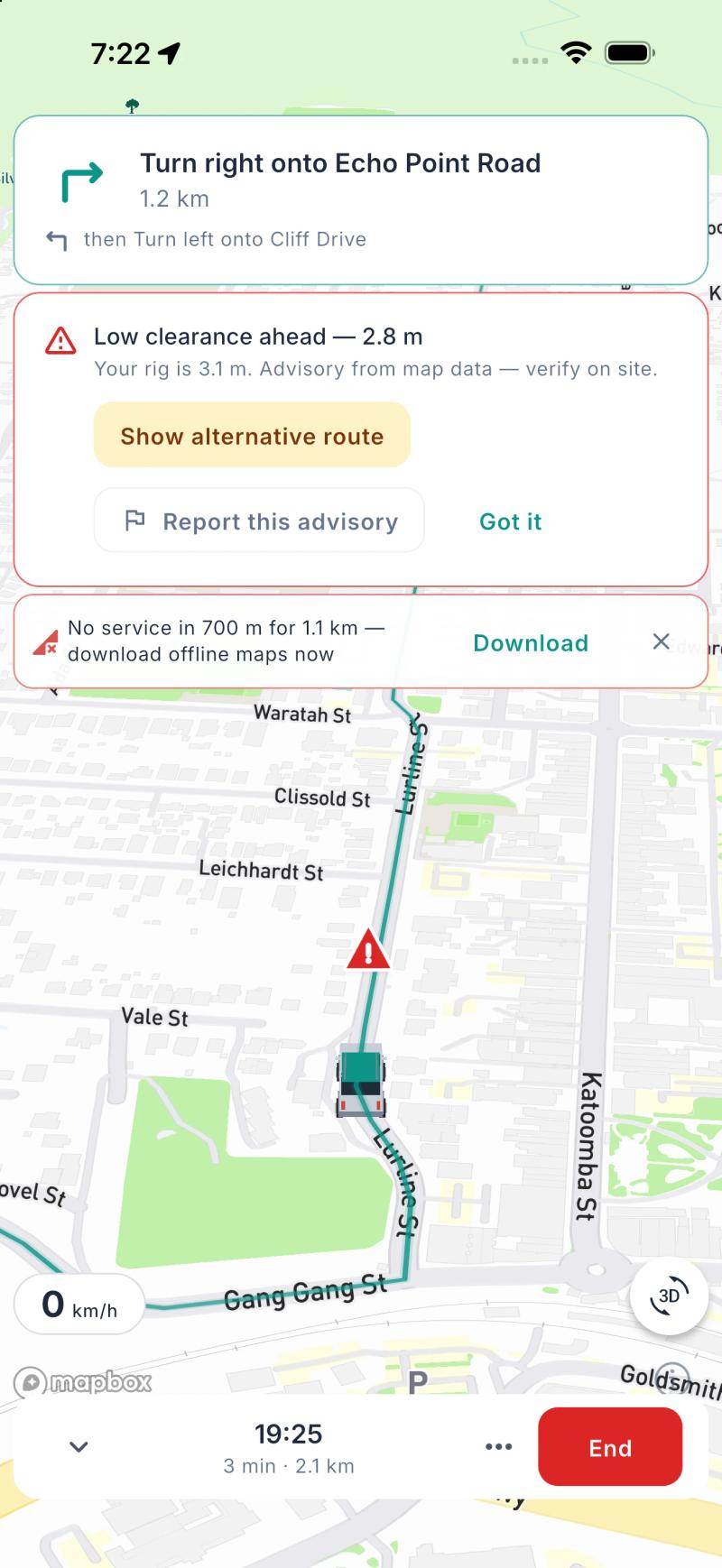
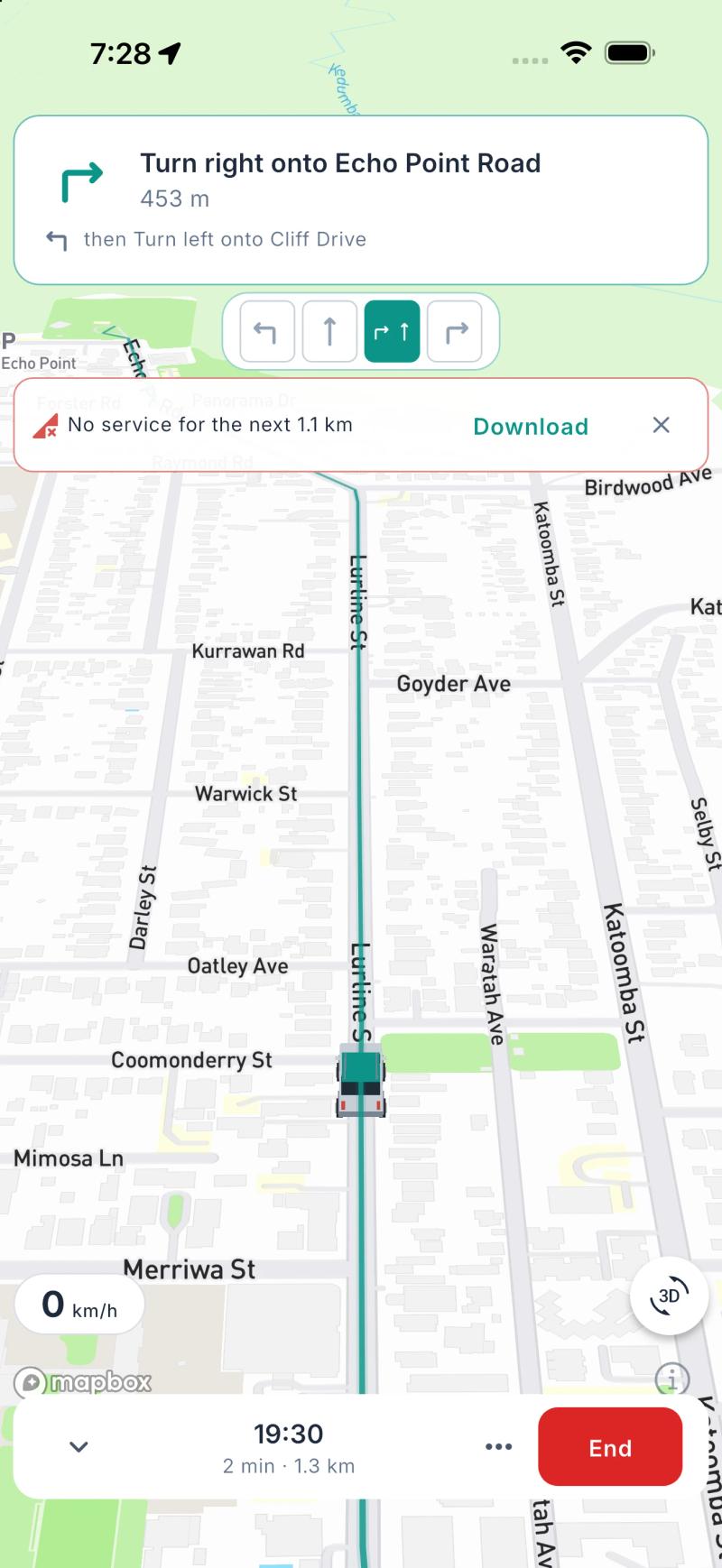
This is the problem we set out to solve with navigation in Ready2Roam 1.2.0. In-app navigation (Nomad Pro) uses the rig in your Garage, including its height, length and weight, so routes are planned around the whole outfit. Along the way you'll get:
- Heads-up warnings ahead of low clearances, steep gradients and long stretches without a break, with the option to take another route where the road data flags a restriction for your rig.
- Lane guidance and roundabout directions, which you'll appreciate on Britain's many multi-lane roundabouts.
- Guidance on your Lock Screen, visible at a glance.
- Offline nav packs, so guidance keeps working where mobile signal drops out.
Road data is never complete, so Ready2Roam's warnings are advisory. Always follow the signs and check clearances on site. You can also send any route to Apple Maps or Google Maps in one tap, free.
The bottom line
Britain's roads reward a little preparation. Know your height in metres and feet, prefer A-roads, follow the campsite's directions for the final stretch, use passing places properly, and trust the signs over the screen. Do that, and the narrow lanes become part of the charm.
Heading to the Highlands? Read our NC500 guide for motorhomes and caravans. Before any trip, run through our pre-trip towing safety checklist.
Download Ready2Roam. Nomad Pro comes with a 14-day free trial.


